Showing posts with label bebop. Show all posts

Wednesday, April 13, 2016

0013 - Miles Davis - Birth of the Cool [1957]


Who: Jazz legend Miles Davis (1926-1991, trumpet) and his nonet (i.e., 9-piece ensemble: piano, bass, drums, trumpet, tuba, trombone, French horn, and alto and baritone saxophone).

What: A collection of recordings Davis made in 1949-1950, this album is remarkable for a number of reasons. First, it features a nine-piece band (nonet)—a rare thing in jazz—which places it at a critical position between the big bands of 1940s swing and the stripped down ensembles of bebop jazz. Second, this is the foundational record of "cool jazz": while the bebop bands played fast and hot, these songs are smooth and cool, even incorporating elements of classical music into jazz. This record is the first of several that established Miles Davis as one of the most important American musicians of all time.

Where: New York, NY through and through.

The jazz clubs on 52nd St where Davis played, New York, 1948.
When: Hosting a late-night cocktail party.

Why: This record is jazz music as elegant and cool as it gets. It is a rare jazz album that manages to be both accessible, even to those who aren't jazz fans (especially given that the average track length is three minutes) and cutting-edge (it is one of the first to incorporate classical elements into jazz). 

Davis and the nonet in the recording sessions for Birth of the Cool, New York, 1949-50.
Microdose: While these songs are short by jazz standards, this is a seamless album from which there is no real "standout" track. We've chosen "Boplicity" because it is one of the few tracks on the album written by Davis (in collaboration with Gil Evans and credited to the pseudonym Cleo Henry).


Additional Dose: This 1946 recording of "A Night in Tunisia" features Davis playing trumpet in the band of the great Charlie Parker, one of the founders of bebop jazz. Davis played in Parker's band before becoming the leader of his own, immediately prior to the recordings that became Birth of the Cool. (Parker died in 1955, never making an LP album in his lifetime, and thus, not featured in our initial list of records).

Monday, April 11, 2016

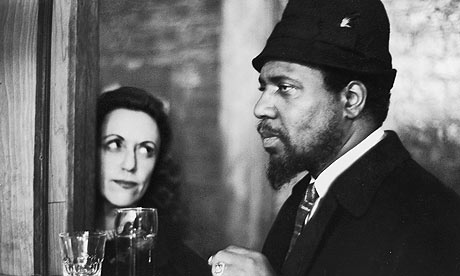
0011 - Thelonious Monk - Brilliant Corners [1957]


Who: Legendary jazz pianst and composer Thelonious Monk (1917-1982) and a six-piece ensemble. 

What: This is one of the most influential and important jazz records of all time. The traditional big band of swing music is pared down to the elemental essentials and while the far out experiments of free jazz are yet to come the compositions are extraordinarily complex. Indeed, this record is on the same level as some of the most important classical music of all time.

Where: New York, NY–and quintessentially so. This music moves will all the different energies of the city.

Monk (L) and others outside of legendary jazz club Minton's Playhouse, NYC, 1947.
When: You want to be moved.
 
Why: This is a stunning record of unimpeachable quality. That all but one of the songs are Monk's own compositions, rather than improvisations on existing songs, makes it even more impressive. Like classical music, this music dynamically conveys an incredible range of moods and feelings without the need of lyrics.  This is music that will take you places.

Monk and the "Jazz Baroness" Pannonica de Koenigswarter, 1964.

Microdose: "Pannonica," a moving and haunting ode to his friend Pannonica de Koenigswarter, the infamous "Jazz Baroness" (a member of the Rothschild dynasty who left her family behind to become a patroness, champion, and friend of many of the most important jazz musicians of the 20th century). Here, Monk plays the celeste instead of the piano, which greatly adds to the song's dreamlike soundscape.


Additional Dose: An incredible solo performance by drummer Max Roach. While drummers often get the least recognition, Roach played on this album as well as many others by jazz legends such as Charlie Parker, Duke Ellington, Charles Mingus, and Miles Davis.

Tuesday, April 5, 2016

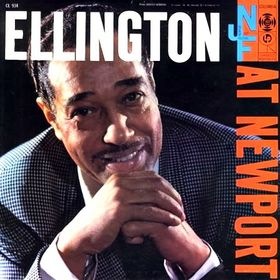
0005 - Duke Ellington - Ellington at Newport [1956]


Who: Duke Ellington (1899-1974), the greatest jazz composer of all time, and his 15-piece orchestra.

What: This album is a live recording of Ellington's legendary performance at the 1957 Newport Jazz Festival, which is widely considered the best performance of his career. At the time of the performance, Ellington's career (and the big band swing of the 1940s that he pioneered) was in decline due to the rise of bebop jazz. Here, Ellington and his band reinterpret his older classics in a hip way that not only revitalized his career, but also provided some of the most famous and important improvisational work of 1950s jazz.

Where: The Newport Jazz Festival in Newport, RI.


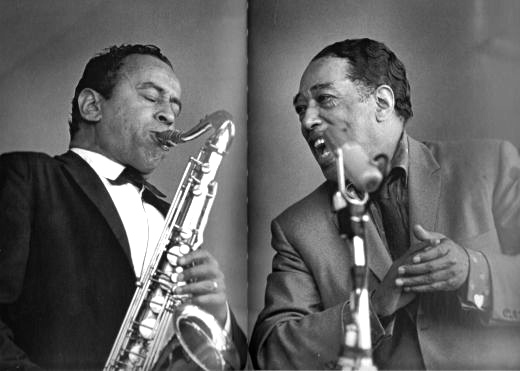
Paul Gonsalves, the saxophone soloist from "Dimenuendo and Crescendo in Blue," with Ellington, ca. 1950s.

When: Anytime, but it was simply wonderful on a sunny spring morning.

Why: This is a stunning and sophisticated album that even listeners who don't like jazz can enjoy. It strikes a perfect balance between traditional big band song structures and forward-thinking improvisation. The atmosphere between the band and the audience after the performance of "Diminuendo and Crescendo in Blue" has to be among the most thrilling live moments captured on record.

Elaine Anderson dancing during Ellington's performance at Newport RI, July 7, 1956.

Microdose: This isn't really a "microdose" because it is the longest song of the concert by far, but this electrifying performance of "Diminuendo and Crescendo in Blue" (originally from 1937) must be heard to be believed. It features Paul Gonsalves's iconic 27-chorus saxophone improvisation, which was spurred on when Elaine Anderson (known simply as the "white woman in the black dress" for decades) jumped out of her box seat and started dancing at the stage, causing the rest of the audience to join her. According to those in attendance, the crazier she danced, the crazier the solo became. After the song ended, the audience was so energized and demanding that the band had to play three encores, while Ellington tried to calm them down.


Additional Dose: Ellington and Gonsalves are reunited 15 years later. This live footage from 1972  demonstrates the effortlessness and mutual admiration of the duo, as they glide into the smooth number.